Snowpocalypse 2026 is here
And a flurry of recommended readings

Greetings from cold and snowy Arkansas.
After a week of meteorological prognosticating, a large storm system finally combined with frigid temperatures over the middle of the country to bring the first major snow of the season to the Natural State. We’ve received a few inches already, and the second round is predicted to hit overnight to bring us nearly a foot of dry powder.

This, combined with below-zero temperatures Sunday and Monday, means we’re likely homebound for the next few days. Thankfully, there’s plenty of reading to keep me busy.
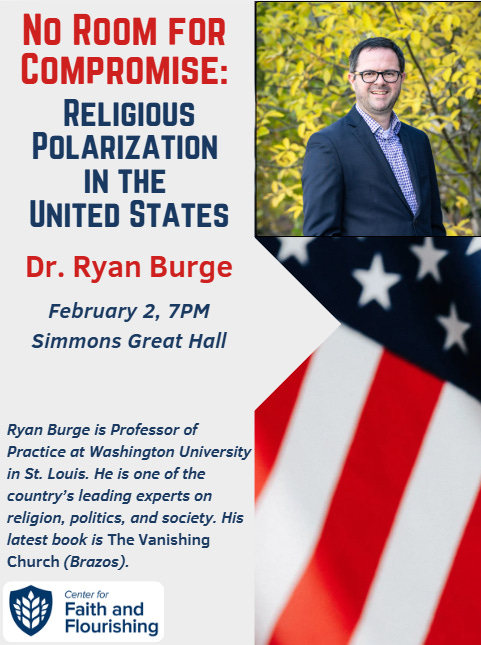
First, I’m checking out Ryan Burge’s latest book, The Vanishing Church, in preparation for his visit to campus next month. If you’re in the area, I hope you’ll join us (details below). It’s been fun to see Ryan—a graduate school colleague of mine—interviewed on some great podcasts, including Ross Douthat’s Interesting Times, where the New York Times columnist called him “the best data analyst tracking trends in American religion right now.”
I’m also reading Arlie Hochschild’s latest book, Stolen Pride. It isn’t exactly a sequel to her marvelous Strangers in Their Own Land, but the purpose is largely the same: to attempt to explain the rise of a certain element of American society often overlooked or overgeneralized. She writes with sympathy in the pursuit of understanding, while managing to keep her distance as a scholar. It’s been great so far.
As for as other recommendations…
Recommended Readings
You can’t clear cut political society (Miles Smith, Mere Orthodoxy)
Over the past decade, evangelical protestants have undoubtedly done their best to cull the forest of secularism in America’s public life. They’ve done this with no small amount of encouragement from others. Many thinkers outside of evangelicalism have recognized a similar need for such pruning and even pruning by Christians. Tom Holland, Ross Douthat, Glen Scrivener, and Paul Kingsnorth have all made some version of this argument as have, arguably, Rod Dreher, Rusty Reno, and Archbishop Charles Chaput. One could even argue that the endorsement of “cultural Christianity” by figures as disparate as Elon Musk and Richard Dawkins is a tacit acknowledgement of this point. There is nothing wrong with Christians pruning secular society. Yet pruning requires skill to be done well, it requires knowledge of trees and biological ecosystems. Done badly, culling a forest can actually make a forest worse off, rather than healthier.
Desecration in Minnesota and the Ecclesiology of Public Worship (James Wood, First Things)
Christians are called to endure disruption with patience and hope (1 Peter 2–4). But they may also appeal to rulers to fulfill their divinely entrusted duties. Such appeals are not demands for privilege or instruments of coercion. They are invitations to act as nursing fathers, ensuring that public worship—the enactment of Christ’s kingdom—is possible. Worship is public. The church is public. Liberalism’s attempt to privatize worship is an ecclesiological error that neutralizes the church’s witness.
The stakes are theological, social, and political. In worship, the King of kings is acclaimed, the new humanity is made visible, and the church anticipates the eternal polis of God. Civil authorities exist provisionally to serve this mission. Minnesota is not an anomaly. It is a reminder that the church remains a public community under Christ—and that rulers are called, as Paul instructs in 1 Timothy 2, to ensure that she may worship in peace.
It’s Not ‘Christian Nationalism.’ It’s Conservative Identity Politics (George Yancey, Christianity Today)
Blanket accusations of racism and authoritarianism are often thrown around by academics and pundits in discussions about Christian nationalism. I am not saying these aren’t real concerns – racism and authoritarianism do exist. But making sweeping charges won’t alter the attitudes of activists if they don’t see those things as the driving factors in their political choices.
[I]dentity politics is featured on the left and the right, and the problems it creates for conservative Christians are not unique to them. My caution is just as relevant for believers supporting progressive causes as it is for conservatives. Instead of falling into the trap of identity politics, both groups need to engage in the public square without surrendering biblical principles and the gospel, which is our ultimate priority.
It’s Not Just What We Teach, but How (Matt Reynolds, Christianity Today)
[N]o civics program can (or should) resolve every last dispute about our renderings unto Caesar. We all benefit from principled educational pluralism, with a healthy assortment of schools—public, charter, private, and home-based—serving the common good by leaning into their peculiarities, not flattening them. Like the Dutch Reformed thinker Abraham Kuyper, I don’t regard the resulting mosaic as a reluctant sigh of squishy relativism. I recognize it as the hand of God’s common grace governing his world.