
Today I begin my tenth year of teaching at John Brown University. This semester I’m teaching three political science classes: American Government and Politics, Politics and Race in America, and Research Methods and Design. I’m unbelievably blessed to be able to ask and explore important questions for a living, in the company of curious students and talented colleagues.
This year also marks my second as Director for the Center for Faith and Flourishing, and it looks to be a good one. In October we’re hosting two speakers for Reimagining Faith and Public Life 2025, but due to scheduling issues we’re bringing them on back-to-back Mondays:
October 6: Daniel Darling, author of the forthcoming book In Defense of Christian Patriotism
October 13: Elizabeth Neumann, author of the recent book Kingdom of Rage
Both events are scheduled for 7pm in Simmons Great Hall at John Brown University. If you’re in the vicinity of Northwest Arkansas, I hope you can join us.
Reading Recommendations
American Christianity’s False Loyalty Test (The Dispatch)
I’ve gotten to know Napp Nazworth well over the years due to my work with the American Values Coalition. In an essay for The Dispatch, Napp discusses a recent First Things article critiquing the work of organizations like AVC and the related J29 Coalition. He begins by describing AVC’s history:
AVC was founded in 2021 to address the problems of political extremism, hyper-polarization, and misinformation on the right side of American politics. We operate from a theologically and politically conservative point of view, as conservatives speaking to fellow conservatives about the problems on our side of the political spectrum.
This model informs the purpose of J29, which Napp describes as “help[ing] pastors with political discipleship so they can better address the effects of these society-wide issues on their own congregations and communities.”
Still, critics—including Megan Basham, author of the First Things article—have found plenty to attack AVC for, including alleged bias stemming from funding sources and the lack of supporters who backed Donald Trump’s previous campaigns for president.
One section from Napp’s essay resonated deeply with me, given that it highlighted the moment in the First Things article where I was singled out:
Basham complains that “the leaders of both groups are exclusively Never Trump” and “none of the teachers associated with J29 and AVC share the outlook of the typical Christian conservative.” What outlook is that? Is it these teachers’ views on the virgin birth? The resurrection? Miracles? Biblical authority? No, none of those. The outlook she’s referring to can be found in the next sentence: “Even its least partisan coach posts exclusively negative or neutral comments regarding the president.” Basham’s formulation comes down to this: They don’t support Trump, so they can’t be conservative Christians.
I am, in fact, the “least partisan coach” from the First Things article. Yet because my social media record isn’t sufficiently positive about President Trump, I am somehow not in line with the average Christian conservative.1 Not because of my political views or concerns, or even my theological or doctrinal views. But because of of my social media account.
This is the essence of politics driving one’s understanding of faith. Ordered rightly, it is our faith that should drive our politics and political engagement. But when someone lets politics (especially in the clunky and limited domain of social media signaling) define what it means to be a true Christian, something is greatly amiss.
Why 536 was ‘the worst year to be alive' (Science)
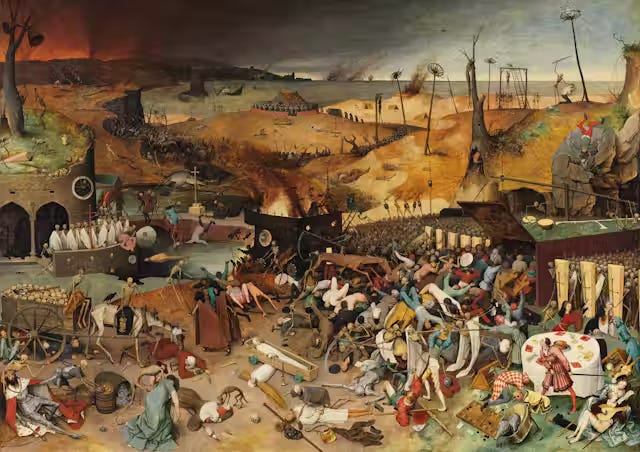
It’s natural to fall victim to recency bias when evaluating our place in history. It’s easy to lament the state of things as “uniquely terrible.” However, it’s always helpful to remember that despite the challenges of our moment—and there are many—things could certainly be worse.
Consider this 2018 article from Science, in which the author details the horrors of the year 536:
A mysterious fog plunged Europe, the Middle East, and parts of Asia into darkness, day and night—for 18 months. "For the sun gave forth its light without brightness, like the moon, during the whole year," wrote Byzantine historian Procopius. Temperatures in the summer of 536 fell 1.5°C to 2.5°C, initiating the coldest decade in the past 2300 years. Snow fell that summer in China; crops failed; people starved. The Irish chronicles record "a failure of bread from the years 536–539." Then, in 541, bubonic plague struck the Roman port of Pelusium, in Egypt. What came to be called the Plague of Justinian spread rapidly, wiping out one-third to one-half of the population of the eastern Roman Empire and hastening its collapse.
Not great.
What Should Pastor Caleb Know About Politics? (J29 Coalition)
Okay, so this isn’t a reading recommendation. But I did sit down with the J29 Coalition’s Caleb Campbell—and fellow guests Amy Black and Napp Nazworth—for a freewheeling conversation about hot topics in American politics, as well as some encouragement for pastors seeking a positive path toward political engagement.
This is to an extent true — surveys show at least 80 percent of white evangelical Christians preferred Trump in the 2016, 2020, and 2024 elections. But this doesn’t seem to be the implication from the article; instead, Basham is suggesting that anybody who isn’t sufficiently deferential to the president on political and policy matters is neither sufficiently conservative nor Christian.